Jul 31, 2012

The Chick-Fiasco: One Follower's Perspective


I've been involved in a couple good discussions about this whole Chick-Fil-A thing the last few days and saw some similar thoughts crop up. I thought I would take a moment and share some of them here.


Chick-Fil-A CEO Dan Cathy raised the ire of LGBT organizations by his public statement of his belief in the definition of marriage, by God, as between one man and one woman. He said:
“We are very much supportive of the family — the biblical definition of the family unit. We are a family-owned business, a family-led business, and we are married to our first wives.” 
—Dan Cathy, CEO Chick-Fil-A 
This statement alone, is perfectly fine in my opinion. I mean, I don't agree with it, but it's fine if other people feel that way. What I don't like, and why I wouldn't eat at Chick-Fil-A if there was one here in Portland, is that the company funds anti-gay organizations with it's profits. I don't want my money going toward funding hate and discrimination. That's strong language, but I don't know what a law against certain people being married is. It's certainly not love. 


For similar reasons, I don't do business with GoDaddy.com. I've moved all of my sites off their servers because of their CEO's hobby of shooting elephants in Africa. CEO Bob Parsons says he is helping local farmers but I think there is another answer and I think the locals make a lot of money off killing the animals. You may feel that Parson's extracurricular activities shouldn't mean you have to pay more for a URL, but I do.


A couple of friends who are athiests/agnostics asked for my perspective as a "Christian". In order to understand the issue from a Biblical perspective, I did some research. I found a lot of elements that contribute to the rhetoric that is coming from the conservative side of the conversation. The one that seemed to point directly to the set of values, captured by Dan Cathy, is Leviticus 20. This is God's Law given to Moses for the people of Israel. 
The LORD said to Moses, “Give the people of Israel these instructions, which apply both to native Israelites and to the foreigners living in Israel. —Leviticus 20:1-2
The following list of laws is pretty straight-forward stuff. Most of it is really easy to follow and that is a good thing because most of it is punishable by death. There aren't any ifs, ands, or buts. Do these things and be put to death. 


Included in the list in verse 13, is homosexuality:
“If a man practices homosexuality, having sex with another man as with a woman, both men have committed a detestable act. They must both be put to death, for they are guilty of a capital offense." 
—Leviticus 20:13
It also covers beastiality, adultery, incest, communing with spirits, and divorce. Oh, and eating unclean animals and birds (not exactly sure if the last one is punishable by death). 


In the end, that list of Moses's is pretty long and if we were to follow it, a lot of us would be going to the gallows. The whole idea of earned forgiveness is not what Christianity is founded on. This all or nothing view of faith is just the same sort of dogma that fuels Al Qaeda, the Taliban, and other fanatical groups around the world. 


There are many people in this world, including Christians and heterosexual people, who would fail to abide by God's law for Moses. Should we put them to death? In light of Jesus's commandments, should we put these people to death? I mean, why mess around with banning gay marriage? Why not ban divorce? Is that far enough? Where do we stop?


I know that nobody is saying we should put gay people to death (well, I guess some people might be). But what should we do with them? The Bible says homosexuality, among other things, requires the penalty of death. If you're going to base laws off the Bible, not the Torah or the Quran mind you, then you can't go half way. Dan Cathy, and others like him, are saying that we are asking for the WRATH of GOD if we allow gay marriage (!). Don't half-ass that one, guys.


Is it open to interpretation? If it is, what else is?


How do we, as followers of Christ, reconcile these laws with the worldly views of today. We can't ignore them, right? It's the Bible... with a capital B. Written by the hand of God and all that. 


Thankfully, there other parts of scripture that give us a stronger directive. This little gem is one of my favorites that is somehow absent in the rhetoric of anti-gay organizations:


Jesus replied, “‘You must love the LORD your God with all your heart, all your soul, and all your mind.’ This is the first and greatest commandment. A second is equally important: ‘Love your neighbor as yourself.’ 
—Matthew 22:37-39


Even if you believe that homosexuality is a sin and that marriage is between one man and one woman, as Dan Cathy does, it is not right for you to cast judgment on these people:


God alone, who gave the law, is the Judge. He alone has the power to save or to destroy. So what right do you have to judge your neighbor? 
—James 4:12
Which commandment should I follow? I guess, since I am a follower of Christ, I'll go with His commandments. This doesn't mean I won't follow the other ones. It just means that I'm not going to pass laws against any people for their beliefs. I'm not going to support the death penalty. And I'm not going to support organizations or businesses that do. Not because I am protesting them or I want you to believe the same way I do. I don't want them banned (which isn't technically possible) and I'm not saying anything derogatory about Dan Cathy or his family or about you if you feel the same.


Just don't pretend it is because you are a Christian. You're kind of ruining it for the rest of us (remember, we're trying to convert these people!).

"Nobody knows what we're for only what we're against when we
judge the wounded 
What if we put down our signs crossed over the lines and love like
You did" 
—Casting Crowns, Jesus, Friend of Sinners
This verse was quoted in one Facebook conversation (a really good and rare religious/political discussion on Facebook, BTW) and it captures the real issue I see with this. I am a follower of Jesus Christ, and I am for gay marriage. Moreover, I have been commanded by God to love Gay, Lesbian, and Transgendered people. Not to mention, Muslims, Hindus, atheists, agnostics, sinners, and the whole lot of you. I even love Dan Cathy. 


It's how God loves me and He says to love you the same. Can I get an Amen?


Jul 19, 2012

Following Fedoroff


7.75 Miles. 7'04" Minutes per Mile.

That's pretty good for me. I felt like I was going to die half the time and at times I wanted to slow down and just coast in. But I didn't. I didn't give up because of the jerk in front of me. 

That would be Nick Fedoroff, gliding along like a gazelle, effortlessly churning out sub-seven minute miles. He is my running partner and one of my best friends and although about mile 5 I hated his guts, I am blessed to run along with him.


We've run together for about 4 years now. We've trained for 5Ks, halfs, and marathons in the rain, snow, and extreme heat. We paced each other in the Eugene Marathon in our first attempts at that distance. He pushes me, I push him. We both get faster. 

When I  run alone I rely on running apps like Nike+ GPS, Runkeeper, and Adidas MiCoach to give me feedback on my runs and they have been an integral part of my evolution as a runner. However, they fail in comparison to the value of trying to keep up with Nick. A running partner is real-real-time. Running too fast? They will tell you. Running too slow? They will tell you and not with words but in a physical way that is immediate and compelling. If your running partner is sputtering, you're running fast. If they suddenly drop dead, you're running too fast. 

One of my favorite things when Nick and I are running is when our casual conversation stops. We have a lot of funny and/or deep conversations on our runs but when the chatter stops I know we are pushing each other. 


Of course, this isn't a post entirely about the bromance that Nick and I have. It's also about the importance of having a good running partner. I've learned it is an essential ingredient to becoming a runner. 

For a beginner, a good running partner is someone who will knock on your door at 6AM and wake you up or at least give you a hard time for bailing on a run. If you are training for a race, looking for speed, or want to go further, a good running partner will help you set goals and show you how well you are doing.


Finding the right running partner can be difficult. I am asked a lot to go running with people and I have to admit, I'm not a good running partner for a beginner. I'm going to go too far or leave you behind. The key is to find someone who is about the same level as you are or maybe a bit more advanced. If you are running twice a week, find someone who is running three times a week. If you are training for a 10K, team up with a person training for the same distance or even the same race. 

The important ingredient here is to start running. Don't wait to find a running partner. You'll probably meet your running partner in the locker room or out on the trail. It's sort of like finding a date. You're not going to find Mr. Right sitting on the couch watching Big Brother. Many races have group runs with coaching. Fitright Northwest has great events every week that are full of people at all levels. 

So go run and keep your eyes peeled for a running partner. You'll be a better runner for it and you just might make a friend. 

May 25, 2012

The Toilet Paper Roll

I told this story a couple weeks ago at my church, Sunset Presbyterian. It got some laughs and I think it made people think. Hopefully it will have the same affect online. At the very least, you'll understand why there are people who call me, "The Toilet Paper Guy".

One of the most important things in my life right now is finding a new house for my family. We are 6 people, plus a dog and two cats living in a 3 bedroom, 1 bath home. Luckily, we have a huge backyard.
One of the issues that crops up when you have 6 people sharing one bathroom (plus the dog) is a constant shortage of toilet paper. 

There are three states of the toilet paper roll:

The ever-present empty roll. Which says, I am an uncivilized monkey and I do not know how to refill a toilet paper roll. 


The three square roll. It says, it’s not empty! I saved you this tiny bit of toilet paper!


The empty roll with a full roll on top. This says, I made an effort, see?

And finally the elusive and rarely seen full roll. Love this one. Never seen it, but I hope to someday. 
I’ve spent many years reviewing this dialog in my head and muttering profanity under my breath, and then shouting the name of the suspected culprit at the top of lungs. 
There a million things like toilet paper rolls in my house. A million little things that any civilized person would just be outraged by. And when you let each one of those things determine the interactions you have with your family, the result is well, kind of dire. Suddenly, 95% of your interactions are negative. “You did this wrong” “Why can’t you figure this out.” The relationships you have start to erode.  
I’ve spent the majority of the last 18 years of marriage and parenthood finding things like the toilet paper roll to be angry about. The result is that anger has dominated my life and the relationships with the people I love most for almost 20 years. I am a nice guy. Someone you enjoy working with, fun at parties... Definitely not someone who would bully his wife or his young children. I came very close to losing everything I have to my anger. 
I sought counseling, I took deep breaths, counted to 10, I tried so hard to deal with the anger that was affecting my life. But I was just dealing with the symptoms. The surface. 
My anger flowed from an empty space in my heart. I had turned away from God and towards the things of this world. I did not guard my heart against the evil things of this world. They filled my heart and drove my words and actions.
It was not until I let Jesus in to my life, praying that He purify my heart, that I began to feel peace. Nurturing my relationship with Jesus, through prayer, bible study, and serving has done more than suppress the symptoms of my anger. His love has filled that space in my heart and now that love flows from it. 
Above all else, guard your heart, for everything you do flows from it.
The most important way you can serve your family is to be a whole person. Seek out the love of Jesus Christ and embrace it with all your heart. Go for a run, take a class, read a book. Find out what your problems are and seek help. Find out what is amazing about you and make that better. Focus your life on being Christ-like, following his command to love God and love others as He does. Purify your heart so that only love flows from it.
Oh, and if you notice someone has left the toilet paper empty... Just refill it.

Feb 27, 2012

Usability Week Report: CRUD is Cruddy

I'm in the middle of the Mobile UX Design session at Nielson Norman Group's Usability Week. We're talking a lot about best practices for Mobile apps. One of the things that stood out was designing forms for mobile. In the compacted world of mobile the pain of forms is made even more excruciating.  But it's not just about mobile and it's not just about forms.

It's about CRUD. 

For all the beautiful things in the world we design, user experience designers spend an enormous part of our day creating CRUD. 

There are many definitions of the acronym, but this is the one I know:

  • Create
  • Read
  • Update
  • Delete
I can't tell you how many hours I have spent designing workflows for entering contact information. And like some sort of sick fetishist, I have totally oohed and ahhed over some slick new error message or country drop down. It kind of makes you wonder if you're still human.

It is all for not. It doesn't matter how awesome that order form is. It can be beautiful and have slick transitions, but it's still a form. It's still another data entry task for your user to complete. Even with autocomplete, a form is still a barrier to what you want your user to experience. 

Anytime you introduce a piece of CRUD you are assigning a task to your user. They want to access data or content, buy something, play a game, etc.  You are asking them for their name. Even if it is essential data, like a Zip Code for a store locator, it's still not what they want to do.

I'm not saying we can't ask people for their Zip Code. In this case specifically, there are a couple options. First, do we know where they are? We probably do. If they are on a smartphone we have GPS. If they are on a WiFi network we may be able to get their location from their IP address. Of course, there are all kinds of reasons why these may not work. If we're designing defensively, we can handle this case.

Beyond the information we can gather from the user's device, we can also tap in to the social networks they belong to. Many sites are using Twitter and Facebook OAuth to get user information. The results are creepy in a spectacular kind of way. Dribbble, Nike+, LinkedIn, etc. use OAuth to get your information and get you signed up quick. Click the button, sign in to Twitter (hopefully you remember your password or are logged in) and you are done. It's not rocket science. 

Facebook "Take This Lollipop Video"
Recently, an interactive video made the rounds. After  logging in or liking with Facebook the video rolls with photos and information from your Facebook account, right down to psychotic killer looking at a Google map of your house. 

Some people might blush at their "private" information being shared with an app or site. Of course, if it's on the web it's not private (don't tell anyone) but that is just my opinion. Moreover, if you take my information and put it in to a truly epic video I am more than willing to give it to you. If you use it to send me a really crappy newsletter, I will complain (and unsubscribe). Think about how many times you've given up your email address for a simple coupon code or a "chance to win an iPad 3"? Your Facebook isn't any more precious and users aren't hesitant to part with it. 

If you have to make your users work, it better be for something good. If I give you my information, give me something great in return. Remember it later too. Don't make me enter it twice or three times. Show me something cool about myself, even if it isn't necessary. I love it when an app brings in my Twitter avatar and updates it later when I change it. Upload an image? I already did that with Twitter. Make my life easier.

And you know what? Maybe you don't need to get that email address RIGHT now. Maybe it can wait. Maybe you don't need any information at all. Many sites incentivize users to enter information to complete their profile even though they can use the site without giving any information at all.

Enterprise apps aren't exempt either. Just because you are some big huge corporate app made for serious enterprise people doesn't mean you can force them in to labor. In fact, it means that any task you give them is compounded by each user.

So, think twice before you add any CRUD. Design it well but realize that pretty and slick don't mean less work. Give your user a reward for their hard work even if it is just a little shiny picture for their universe. And in the end, if you can get by without it, do that. 


Dec 15, 2011

Infographics and The War on Data

There are few things I hate more in the world than Fox News and Infographics. Although my dislike comes from different things, they both share a common disregard for representing data and in fact, do many things that actively work against the truths that lie in data.

Let's start with Fox News.

I'll just set aside all the misinformation and hate they spew and the entire novel one could right on how the 24  hour news cycle is ruining our society. I'll just focus on this one example featured recently on several blogs :

Read the Blog Here
Here, Fox has distorted the X-Axis of the graph to understate the drop in unemployment. Even a glance, you can see the data is just flat wrong. 9.0% is represented as the same as 8.6%. Over and above that, the visual design obscures the data behind a barrage of beveled metal.

However, if you look at the original chart from the Bureau of Labor and Statistics it isn't much better.


The drop from 9.0 to 8.6 is shown as nothing short of precipitous. 0.4% looks like free fall. That being said, the 0.4% drop is a pretty big drop for a 11 month period historically. I went back and looked at Google's view going back to 1950 and it is a "big" drop. I would argue that looking at unemployment on a yearly basis might not be the best way to evaluate the state of our economy. 

In my high school economics class, I remember reading How to Lie with Statistics. It was eye opening and has made me squint my eyes and tilt my head to the side whenever confronted by a table or chart. The principles of good data visualization outlined in that book and then further expanded upon with Tufte, Few, and McCandless have defined the way I look at design and data. With little effort one can drastically change the way data is interpreted. Whether by accident or with nefarious motives the consequences can be dire. 


That is why infographics piss me off. These ubiquitous towers of pop culture data are used for everything from the Oscars to world hunger to biking, all with equal disregard for the information they are supposedly trying to convey. I don't think anyone will disagree that infographics are the fast food of data visualization. A certain element of fun is needed to capture our attention, right? 

Of course, you could say the same should be true for every piece of data we share from a detailed report to an executive dashboard. Data should resonate with the audience and should be easily understood. It should provide insight and be compelling. I mean, a carefully placed icon or bar chart can do wonders. People just love those little spark lines too.

Infographics veer off in to the absurd when they actually inhibit access to the data. They do this in a couple ways. First, they obscure the data (info, if you will) behind "clever" graphics. Using color or icon as a visual cue is useful but when a giant Wii controller is used to point to a tiny single point of data, you're just filling space.

The opposite is also true. When the infographic is 3000 pixels tall and chocked full of 500 examples of how Facebook is taking off, you haven't edited enough and I don't know what to look at. Look, infographic designers... you're DESIGNERS. This is your job. Communication. You should be using the same principles you use in that Applebee's Fire Grilled Food brochure you're working on. You wouldn't let Mr. Applebee tell you to put every piece of flair on that thing, right? 

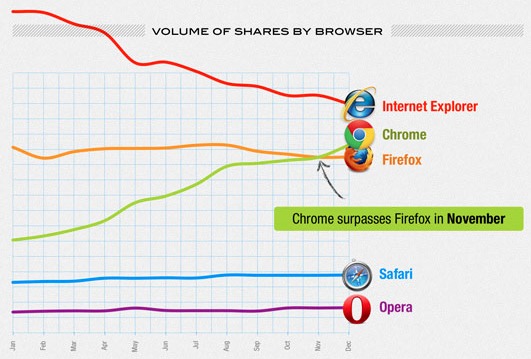
Infographics second sin is how they distort data. Just like Fox News, they make mountains out of molehills and just plain misrepresent data. Take the above example from AddThis' 2011 Social Sharing Trends infographic. It's actually one of the best examples of an infographic I have seen, so this is pretty minor on the scale of infographic atrocities. However, in this visualization they do a couple of things wrong:

  1. Lack of context—Without any context, like the overall growth per browser, this data really doesn't say anything. I'd be willing to bet that if we overlaid Chrome's user growth, we'd find that there is a strong correlation to the growth of shares. Because who is going to start using Chrome but still share via Firefox? The data is interesting but only meaningful when paired with the user growth. 
  2. Too many data points—Do we really need to show Firefox, Safari, and Opera? IE's precipitous decline and Chrome's meteoric rise are the real story. This is a brawl between the two dominant players in the space. Opera is a footnote in history and Firefox is only in the fight because of Fire Bug's dev tools. Strip the nobodies out and focus on the main event. Include Firefox, but only in that  Chrome surpassed it. 
  3. No Mobile—Speaking of browsers, where are the mobile browsers? That's a fight I want to see.
Everything else on this infographic is actually really decent. It's simple, readable, and more efficient than just simply reading the information in a paragraph. Most other infographics fail miserably in this area.

Case in point; this one is from Mashable's Top 12 Infographics of 2012 (THE TOP TWELVE!):


This little gem, all 4.9 MILLION browser crushing pixels of it, is simply trying to communicate how airlines are using social media (really going after a controversial topic) but it fails in so many ways.

  1. Huge title— If I could load this thing on a mobile device, it would be useless. On my MackBook Air, I have to scroll a whole page just to see data.
  2. Same information, 50 different ways of visualizing it—Ed Tufte would be rolling in his grave shouting "small multiples!" if he saw this. And if he were dead.
  3. Nothing Compares—No way to compare the data. I wonder how NW Airlines and Jet Blue stack up against each other? 
  4. Low quality graphics— If you're gonna make an infographic, really go for it. Don't mess around. 
  5. Waaaay too much info— FIVE THOUSAND pixels tall! You lost me at around 800px. Edit down the information just the way you would a good news article. 
I could go on and on. Really. The final criticism, and one that pretty much every infographic suffers from, is that a well written paragraph with a couple editorial images would be a hundred times more effective at conveying the data. 

Here is my challenge:

Start with the data. Edit an unformatted list of metrics down to the bare essentials. Find the correlations and interesting stuff. Then think about the story you want to tell. If graphics are needed to amplify the story, use them. But don't mess with the data. A bar chart is a great way to show comparison. It is your friend. That 3D donut chart? Not your friend.

Basically, apply design principles to information. Something you should be doing anyway. 

Oh, and make it all dynamic with HTML5. This huge JPEG thing is dumb. We can do better. 

Dec 11, 2011

The REAL Reason for the Season

As I entered Sunset Presbyterian Church this morning the sound of our music ministry filled the halls. I love this team. They rock. Seriously. Jay McKinney and his team along with the amazing production of Janet Fraser never fail to reach my heart and move me in profound ways. 

However, this morning something made me roll my eyes. O Come, O Come Emanuel. Not another Christmas service. Ugh.

This time of year the message at Sunset and churches everywhere does a hard right turn. It's the birth of our Savior! The pews are filled with visiting Grandparents and kids home from college. Suddenly, we're singing Christmas carols to a full choir and the orchestra that will be performing at the concert that night. We're hearing stories of angels and virgin births. We're sitting and watching instead of standing and worshipping. 

Yeah, I'm a real bah-humbug. I shared this opinion on the way out of church a couple Sundays ago and was glared at by anyone within earshot. My wife especially. She told me I shouldn't share this opinion with anyone else. Even her.

But I really don't like it. 

This morning I sat there in service pouting because we were sitting. I thought, "Hey May-Decemberers! Welcome to my church. We STAND during service. This ain't Wisconsin!"

I prayed for God to focus my heart. So many things can distract you from worshipping God and hearing his message. I've learned the hard way to ignore them and try to find a place to connect. But I just couldn't do it. I was completely wrapped up in my own inner dialog. 

The words of these songs just don't touch my heart. The Nativity story is wondrous. I love thinking about that time and what it must of been like. I believe it, but it just doesn't seem relevant. I feel like we're trying to PROVE it is real when faith alone is what we should rely on.

Then something profound happened in my soul. About two thirds away through I went from Negative Nancy to a man weak in the knees in worship. A favorite song started. Hillsong's Stronger melted my cold heart.  

The words, focused not on Jesus's birth but on his LIFE revealed to me why I feel so resentful this time of year. I immediately stood to my feet, surrounded by my fellow parishioners sitting on their hands. There were a few others standing and to my surprise the rest of the congregation rose to their feet and sang. The Holy Spirit moved us. 

But this isn't a post about a moment in church. This isn't a story about an Ebeneezer who doesn't get it and is shone the truth about the world. This is the story of the real reason for the season.

It actually began the day before. My good friend Ryan Russell gave me a thank you gift. I could write (and may write) an entire post about how amazing Ryan's company, Cohdoo, is and how those little things really make it an honor to work for him. The gift was Steve Jobs biography. I read a little of it that day and one quote stands out:

The juice goes out of Christianity when it becomes too based on faith rather than living like Jesus or seeing the world as Jesus saw it.

He said that religion was at it's best when it emphasized spiritual experiences rather than received dogma. I think this is what is gnawing at me this time of year.

I believe the story of Jesus's birth are true. But I do not believe they are the truth about Jesus. When I celebrate a friend's birthday, yes I am celebrating their birth. But I am really celebrating their life. When I think about Jesus and his teachings in the bible, I celebrate His life. He was an amazing teacher. Studying the Bible never ceases to produce mind blowing realizations about every facet of life.

It was important (and still is I guess) that Jesus have a birthright. He was the king of kings. Prophets and wise men had to prove he was authentic. Kind of like the ancient version of insisting someone produce a long form birth certificate. The Nativity is an important part of it.

So, for all you non-believers and May-December Christians who get dragged to church for Christmas and Easter: Your missing out.

You're also making it worse for me. You're only seeing part of the story. Sure, it's exciting and those songs are easy sing but they don't really capture what it is to be Christian. It isn't why I worship God. It isn't why I follow Jesus.

I follow him because of his life.

Update!

I wanted to thank the folks who have commented and talked with me about this post over the last few days. Especially, my wife Amy. I can't emphasize enough that last Sunday was a profound moment for me. It was a spiritual epiphany.

It left me with a new appreciation for the story of nativity and only deepened my understanding of Jesus's story. While O Come Emanuel isn't my favorite Christmas song, you'll find me listening a little closer to it next Sunday.

Thank you.

Dec 7, 2011

"Working From Home" Without the Air Quotes

The Crew

Yesterday I worked from home. No, I didn't "work from home". I flat out worked. Like a mad man. If I list out the things I accomplished it's kind of mind blowing:


  1. Combed through pages and pages of user interview notes to find tasks for a mental models exercise.
  2. Conference call with sales to iron out some SOW issues.
  3. Caulked the bathroom sink.
  4. Hung Christmas lights in the front yard.
  5. Moved the Christmas tree in the house.
  6. Spackled the ceiling.
  7. Sanded the bathroom ceiling for repainting.
  8. Cooked Mexican Crockpot Lasagna.
  9. Called the repair folks about fixing my TV.
  10. Designed a homepage feature for a freelance client.
  11. Finalized some logo elements for another.
  12. Played an hour of Call of Duty MW3.
  13. Read some email.
  14. Player with the kids.
  15. Cuddled with the kids.
All this while wrangling my 18 month old daughter and 3 year old son. Whew!

I was inspired. Maybe a little insane. But it didn't feel like a lot when I was doing it. And it makes me wonder why I don't work from home more often. I got a LOT done for Webtrends (probably more than I would if I were on site) while at the same time getting an enormous amount of home tasks done.

Why did this happen? Should everybody work from home all the time?

I don't think the answer is yes. I am glad to be back at work. But how can I get the same level of productivity at work as I did at home?

I think the answer lies in the location. Many of the things I accomplished yesterday have been on my "honey-do" list for months. My wife has attempted to walk that fine line between nagging and gently nudging (bless her) with mediocre results. I am a busy guy and it is very easy to focus on other things, especially when I'm at work.

As I sat on the couch listing mental model tasks out on my MacBook Air the house just started to speak to me. I could see that spot on the ceiling that needed spackling. I could see the tree sitting on the front porch  and the TV that needs fixing. When the kids went down for a nap I started taking care of things. And as I did one thing I would see another. When the kids woke up I couldn't ignore them so I cuddled and played before diving back in to work. When 4PM rolled around I knew I needed to get that crockpot going. Once it was in it was back to work.

The key was living and working surrounded by the things that needed to be done. Nobody told me they needed to be done, I did them because I could see them staring me in the face. 


Now let's think about work. At work we are surrounded by things that stand in the way of getting things done. Cube walls, co-workers, internet (and those tempting cat videos), managers, email, meetings... the list goes on and on. Once we wade through a pile of email we are called off to a meeting and then whoa, it's lunch time already.

It's amazing what happens when you finally get around to opening up that Photoshop file or piece of code what you see. All the sudden you are surrounded by what needs to get done. You can see how things fit together, a missing element here, an unwritten function there. Once you've dived in you start to get moving. Unfortunately, that meeting in 15 minutes or visit from a co-worker are likely to distract you.

Some people respond well to the frenetic ADD work environment. I have to admit, I love juggling projects. One single task leaves me running to Facebook or searching for distraction. However, interruptions aren't good for me either. 

At home, I defined my tasks. I didn't have a list I was checking off (lists don't do me good either) but I had the freedom to concentrate on whatever it was I wanted to and get it done. If I wanted to play Call of Duty for an hour I could. If I got in to the bathroom to sand the ceiling and saw the sink needed caulking, I could do that. I knew I needed to get that mental model project done but I could gauge how much time I needed and get back to it when I needed to.

I found myself working in 90 minute chunks. There is a lot of productivity data that points to this being an ideal cadence. Focused tasks for 90 minutes and then a break. Repeat. At most of our jobs we're expected to come in at 8AM, start working, take an hour for lunch and work until we leave at 5PM. Then we are invited to meetings and interrupted the entire time. It's no wonder productivity and motivation are many times lacking.

Of course, we aren't going to live in a world with no meetings or email or internet cats. Interruptions and distractions are a necessary part of life. However, we can do something to make interruptions work WITH our natural cadence instead of against it. I'm looking to duplicate the productivity I had yesterday at home and I think these things will help:

  1. Define my own task list. Being the master of my own internal todo list gave me the flexibility to follow the path before me. If mental models was what was in front of me I could focus on that. When I was ready to move on, I switched to something else.
  2. Focus. This is harder than it sounds. I think I was able to do it because of a couple things. First, I took care of distractions in ANTICIPATION of the focus I would need. If the kids were climbing on me, I played with them so they wouldn't be when I was trying to work. Second, I made it clear I was working. I told them (as much as you can tell an 18 month old) that I was working and gave them something else to do. This pretty much directly translates to bosses and coworkers.
  3. Flexible hours. I took a two hour lunch. I hung Christmas lights and played Call of Duty. At 4PM I got dinner prepped. I came back to my work at 7PM. It worked.
We spend so much time not doing work at work. We're expected to deliver a million things to do but are given a million distractions (sometimes even other things to do). It's time to take back the work day and get things done. 

Jun 27, 2011

This was supposed to be a comment on How Gadgets Are Ruining Cars

This started out as a simple comment on this post by Gizmodo. After a few paragraphs I decided I should just blog it:

I drive a 1964 Buick Skylark. No power windows or doors, no gps, no fuel injection or electronic ignition or air bags. Even the one luxury it does have, power steering, is not like the speed sensitive stuff you have on modern cars. It will kill you if you aren't careful.

It's a joy to drive. The sound, smell, and feel of it are like no other. I feel at home in it. It will handle well, if you know how to drive it.

Don't get me wrong, I love gadgets. And in reality, I DO drive with one. My iPhone plays the role of stereo, gps, etc. But when gadgets become the thing that defines the experience of driving, they ruin it. You're no longer designing a car for driving. You're designing it as a thing to increase productivity or listen to music in. And that is where things go wrong.

The gadgets aren't limited to the interior either. All the suspension and driveline gadgets like traction control take away from the feel of the car. They allow people to just hoon a car around a turn without care for safety of efficiency. I'll beat you in that car. I'll beat you because I don't depend on a computer to correct my turns.

I also believe people drive more unsafely in cars because of gadgets. Not because of "driving qwerty" or because their trying to do an excel spreadsheet while doing 80. No, it's because of all the safety gadgets in cars.

When I look down at my steering wheel, hard edges gleaming with chrome, I know it's gonna hurt if I get in an accident. There is no air bag. Hell, I don't even have shoulder belts. My face is gonna eat that steering wheel. But I think that makes me a safer driver.

People are driving around in super-insulated, air bag cocoons that create an illusion of safety. People take more risks, less care with the way they drive their cars. And this makes the road more dangerous for everyone else.

TwitterFeed